



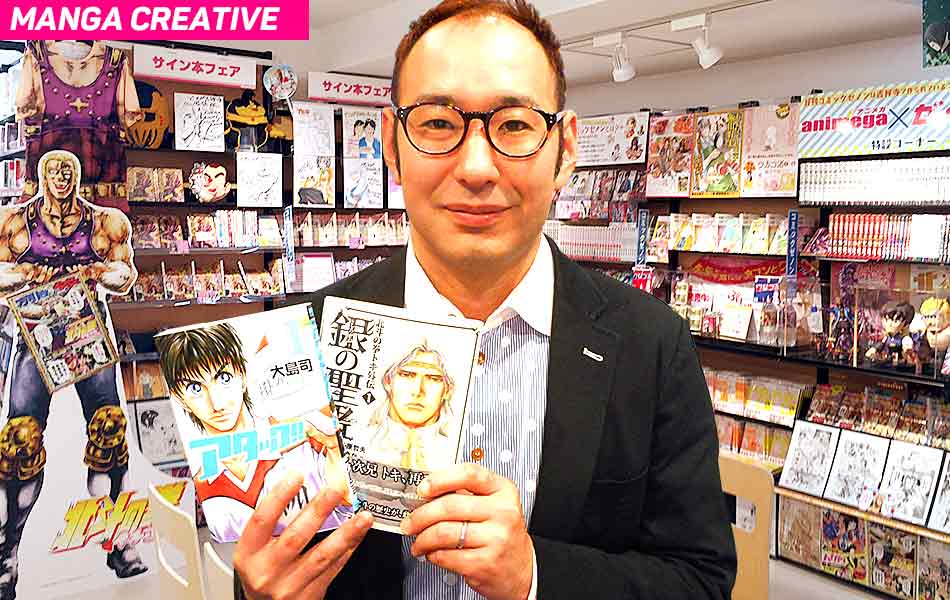


Mr. Ishikawa, with two of the manga he served as the editor-in-charge:
‘Attack!’ by Tsukasa Oshima, and “Silvery Savior: Fist of the North Star Toki Side-Story” by Yuka Nagate

Here’s a sample of an order sheet!
It clearly recommends the manga ‘Chiruran’ based on some obvious data, like this!
1: 48.8 % of the readers are Female! Sellable to female readers in their 20s!
2: ‘Chiruran’ is a story of Shinsengumi, the samurais who live in late Edo period. A new online game “Touken Ranbu” is causing a big buzz, especially among female fans – whole Samurai genre is gaining momentum right now, so we prepared more reprints to go with the latest volume!
*Editor’s note: “Touken Ranbu” is a PC game which features famous Japanese swords. It is now very popular among the young ladies!
3: We sent out “Pop-up signs” which include the swords used by the story’s heroes Kondo, Hijikata, and Okita. “Please consider placing them not just in the comics section, but also in the “Swords fair” you may have in your stores!” Japanese book stores often have themed “Fair” to sell new selections bases on trends.
Hmmm, I think it’s precisely because Mr. Ishikawa has worked as an editor that he feels so strongly about this topic. The sales team tend to meet more people than the editors, so they can probably sense how their work is changing people’s lives. Creating books is a very important job, but it’s clear that selling them is just as important! Next time on Manga Insider, Mr. Ishikawa is going to tell us about the future of the manga industry, not just in Japan, but all over the world! What will be necessary to survive in the manga industry of tomorrow? How do the editors need to adapt? And how much potential does SMAC! have for the future? Don’t miss the next episode!
Mayu’s Point!! The circulation of books in Japan
In the article, Mr. Ishikawa mentioned “returning books”. To properly understand his comments, let’s discuss how books circulate in Japan. In Japan, regardless of which bookstore you go to, the price of a new book will always be the same. The idea behind this is that all customers should be treated equally, and be able to buy books at a fair and consistent price. Of course, both the publisher and the bookstore want to sell as many books as possible. In an ideal world, the publisher would send as many books as they could, and the bookstore would sell them all. However, sad reality is that sometimes books don’t sell. And because of the rule of “equal prices”, the bookstores can’t just sell them at a discount price to clear the stock. Instead, when books don’t sell, stores can simply return the books back to the publisher. – So they can return the books and get fresh stock? What a convenient system! Yes, but means extra costs in transport and unrecovered royalty (paid upon printing) for the publisher. This is where the distributors come in. They act as intermediaries and decide how many books should be sent to each store. – What are the advantages of going through a distributor vs. doing business directly? The distributors act as an impartial observer, who looks at the situation of both sides (the publishers and the bookstores) and moderates the circulation of books. For example, if a bookstore says “We’ll sell 100 copies of this popular manga!” but they only end up selling 50, and send the rest back, then the publisher loses out. To prevent a situation like that, the distributors will only send a reasonable number of books that they feel confident the bookstore can sell out. Additionally, if the bookstores can’t sell out the stock, then the next time they place an order, regardless of how popular they think the product will be, they’ll probably be sent less than they requested. That’s what I meant by “there’s a penalty for returning the books”. With this system, if the bookstores over-order, then they’ll be penalised later, and lose future business opportunities. So the stores have to consider how many books they can realistically sell, and be cautious with their orders. Even more so if the product is a new manga.
  So we have to be responsible when we recommend books. The publishers have each unique ways of promoting their works to the bookstores and the distributors. At Comic Zenon, our approach is to bring the editor-in-charge of the manga, to work together with the sales team, in meeting distributors and doing presentations. This way, we have an open line of communication right from the readers in bookstores, right to the core of manga creation. “Knowing you readers” is one of the most effective assets of creating manga, and we use this “sales opportunity”, also as an “Opportunity to gain valuable insights to the readers’ mind”, that will surely help in creating the next masterpiece!
 Ishikawa-san is not only passionate, but insightful and a deep thinker when he works on his duties. I can’t wait to see him making the next “Happy Encounter”, to come in thousands and millions! Have you ever experienced the joys of “becoming happy by a manga”? What kind of manga has influenced your life? Please voice your opinions in the comment below! Encouragements and loveletters also welcome 😉 [catlist name=”MANGA INSIDER MAYU” thumbnail=”yes” thumbnail_size=160 content=”no” date=”yes” dateformat=”M j, Y G:i” template=page_list]
RELATED ARTICLES :
-

Making a Mangaka: #12 Hiromu Arakawa
-
manga nutcracker#8
-
MANGA INSIDER MAYU #14 –LET'S GO TO THE PRINTING FACTORY!
-
SMA15 Moments of… CRYING: Himuro
-

MANGA INSIDER MAYU #6 – HOW DO YOU BECOME AN EDITOR?
-
Shihan says "Not all Climax of a story need an enemy or dragon to be defeated"
-
Shihan says “Reinventing and Originality”
-
Manga Nutcracker #23 – Houseki no Kuni ( Land of the Lustrous)
-
Manga nutcracker #6 – Mahoutsukai no Yome " The Ancient Magus bride"
-
MANGA INSIDER MAYU #2 LET'S ATTEND THE MEETING!